Signeasy vs DocuSign (2026): Pricing, Limits, QES and a Third Option
Compare Signeasy and DocuSign on US pricing, sending limits, QES, storage, HIPAA and APIs, then see where Sign.Plus fits as a third option with unlimited requests, QES on every plan and published prices.


- Signeasy Business offers unlimited sending with fair usage restrictions. DocuSign Standard and Business Pro each include 100 envelopes per user per year.
- Signeasy sells SMS, bulk send, SSO and HIPAA through sales. DocuSign puts QES, data residency, SSO and HIPAA on quote based Enhanced in the US.
- No QES offering was found on Signeasy's reviewed public pages. DocuSign lists QES on US Enhanced, while Sign.Plus offers it on every plan including Free.
- Signeasy says personal data is mainly processed in the US, with no storage choice published on the reviewed pages. DocuSign residency is on Enhanced. Sign.Plus Enterprise offers 43 locations.
- Choose Signeasy for per seat sending, DocuSign for its broader team packaging, or Sign.Plus for unlimited requests, QES on every plan and published Enterprise compliance pricing.
Signeasy vs DocuSign is a comparison of per-seat sending and envelope-based billing. Signeasy removes its sending cap on Business, subject to fair usage, while DocuSign meters envelopes on its US team plans. The difference affects budgeting, verification, compliance and storage. We tested Signeasy and DocuSign hands-on with a real test agreement sent through each, and we keep retesting both products as they change.
This DocuSign vs Signeasy guide uses US plan details verified in November 2026. It also introduces Sign.Plus as a third option for teams that want unlimited requests, QES on every plan and published prices for storage choice and HIPAA.
Signeasy vs DocuSign at a Glance
| Feature | Signeasy | DocuSign | Sign.Plus |
|---|---|---|---|
| Pricing model | Per seat | Per user, with Enhanced by quote | Per user, with published plans |
| Sending limit | Personal: 5 contracts per month. Business: unlimited, with fair usage restrictions | Personal: 5 envelopes per month. Standard and Business Pro: 100 per user per year | Unlimited signature requests on Professional, Business and Enterprise |
| Signer verification | Passcode and biometric authentication; signer authentication on Business Pro | Email access codes on all plans; ID verification is an add-on on Standard and Business Pro | Per-recipient passcode, SMS code and ID Check |
| QES | No QES offering was found on Signeasy's reviewed public pages | QES is listed on Enhanced in the US | Every plan, including Free, at $5 per recipient |
| Storage region | Personal data mainly processed in the US; no published storage choice | Five regions on Enhanced, set at account creation | Switzerland by default; 43 location choices on Enterprise |
| HIPAA | Sold as an add-on through sales | Enhanced, through a BAA | Enterprise, with Advanced Security Controls and a signed BAA |
| Company | US e-signature company | DocuSign, Inc., San Francisco | Swiss provider by Alohi, Geneva |
Signeasy or DocuSign: Which Should You Choose?
The better fit depends on what your team sends and which controls it needs.
- Signeasy suits a small or mid-size team that wants per-seat pricing and unlimited sending from Business, and can either work without SMS, bulk send, SSO and HIPAA or buy them through sales.
- DocuSign suits a team that wants its broader team features and partner integrations, can track envelopes, and is prepared to quote Enhanced for QES, residency, SSO or HIPAA in the US.
- Sign.Plus suits a team that wants unlimited requests and QES across plans, with Enterprise adding storage choice, SSO and HIPAA at a published price.
What Are Signeasy and DocuSign?
Signeasy
Signeasy is a US e-signature company. Signers pay nothing and need no account. Business includes unlimited sending, subject to fair usage, with five shared templates, reminders, sequential signing and an admin dashboard. Business Pro adds unlimited templates, roles and permissions, approval workflows, custom branding, signer attachments and signer authentication. Offline signing, mobile apps, 2FA login and an audit trail are available on all plans.
DocuSign
DocuSign, Inc., based in San Francisco, is the well-known brand in this comparison. Its eSignature range runs from Personal to Standard, Business Pro and quote-based Enhanced. Standard and Business Pro add team templates, permissions, reports and workplace integrations. Business Pro adds bulk send, PowerForms, payment collection, web forms, developer access and more than 1,000 partner integrations.
What Is the Main Difference?
Signeasy's core team offer is per-seat pricing with unlimited sending from Business, subject to fair usage. DocuSign's core team offer includes more plan-defined features but limits Standard and Business Pro to 100 envelopes per user per year. Both put important controls behind sales: Signeasy for SMS, bulk send, SSO and HIPAA, and DocuSign for QES, residency, SSO and HIPAA on US Enhanced. Sign.Plus is the third option, combining unlimited requests with QES on every plan and published Enterprise compliance features.
How We Compared Signeasy and DocuSign
We read vendor pages and sent a test agreement through each in November 2026. Our review covered pricing, limits, security, privacy, APIs and contract terms. In the hands-on test, we recorded field placement, sending options, default expiry, signer steps and signature presentation. We also checked compliance by plan rather than treating a company-level certification as a plan inclusion. We applied the same plan-by-plan approach to Sign.Plus as a third option.
1. Signeasy vs DocuSign Pricing
Signeasy Pricing
| Plan | Annual price | Main inclusions |
|---|---|---|
| Personal | $10 per seat per month, or $120 a year | Unlimited signing and 5 contract sends per month |
| Business | $20 per seat per month, or $240 a year | Unlimited sending with fair usage restrictions, 5 shared team templates and automatic reminders |
| Business Pro | $30 per seat per month, or $360 a year | Unlimited templates, workflows, custom branding and signer authentication |
| Build Your Plan | Sales quote | For 5 or more seats or high volume; SSO, HIPAA, SMS, bulk send, 21 CFR Part 11 and API |
Annual billing saves up to 33%. Signeasy offers a 14-day free trial, and its help center also describes a Free plan limited to three documents. On Business Pro, SMS sending, bulk send, HIPAA and SSO are sales add-ons without published prices.
DocuSign Pricing
| Plan | Annual upfront | Annual, billed monthly | Month to month | Users and sending |
|---|---|---|---|---|
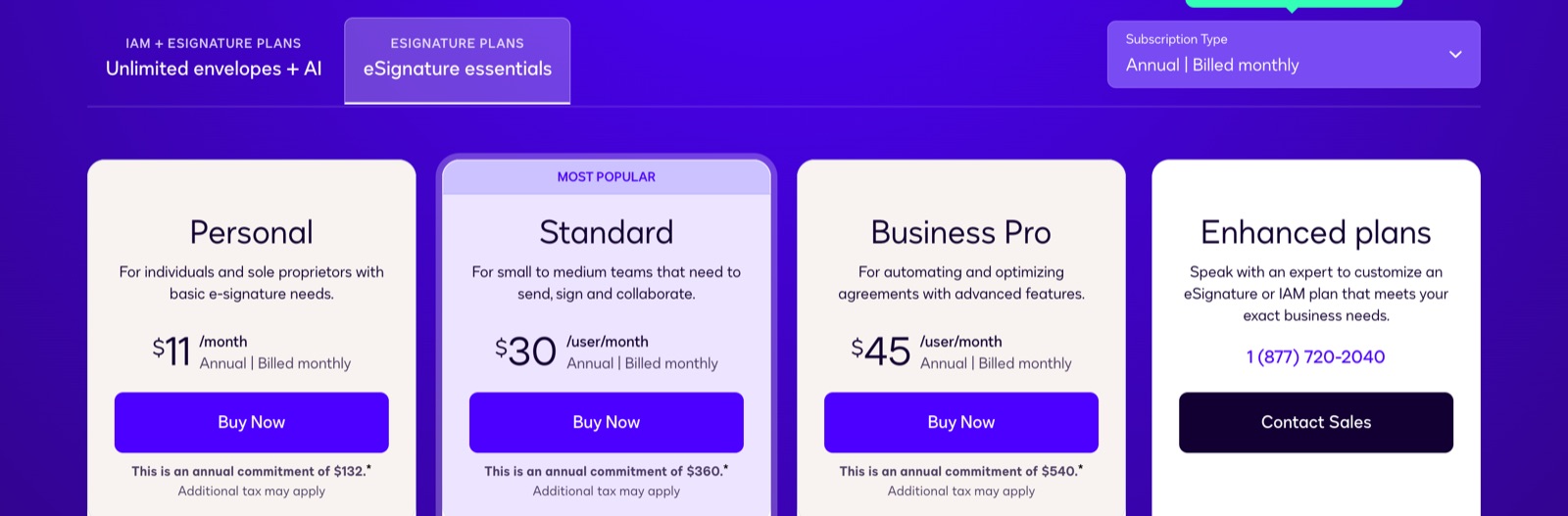
| Personal | $10 per month | $11 per month, or $132 a year | $15 per month | 1 user and 5 envelopes per month |
| Standard | $25 per user per month | $30 per user per month, or $360 per user per year | $45 per user per month | Up to 50 users and 100 envelopes per user per year |
| Business Pro | $40 per user per month | $45 per user per month, or $540 per user per year | $65 per user per month | Up to 50 users and 100 envelopes per user per year |
| Enhanced | Contact sales | Contact sales | Contact sales | 50 or more users and custom envelope limits |
Enhanced is the plan formerly sold as Enterprise. Separate IAM plans add AI agreement management, Workflow Builder and unlimited envelope sends, but their prices are not covered here.
For Standard and Business Pro, SMS delivery starts at $0.36 per delivery and ID verification at $2.40 per attempt. Both plans include five SMS deliveries and five identity verifications as a one-time bonus. For more plan detail, see the DocuSign Standard vs Business Pro guide.
How Much Does Signeasy Cost Compared With DocuSign?
At the entry paid tier, both display a $10 monthly figure on annual terms. Signeasy Personal costs $120 a year, while DocuSign Personal is paid annually upfront. Each allows five sends per month, but DocuSign Personal is limited to one user.
For teams, Signeasy Business is $20 per seat per month annually, compared with $25 per user per month for DocuSign Standard paid annually upfront. The Business Pro tiers are $30 and $40 respectively. The lower sticker price does not settle total cost: Signeasy's sales add-ons and DocuSign's envelope use, verification fees and Enhanced quote can change the budget.
How Signeasy and DocuSign Pricing Compare With Sign.Plus
Against DocuSign, Sign.Plus Professional is $19.99 per user per month annually, versus $25 for DocuSign Standard paid annually upfront. Sign.Plus Business is $29.99, versus $40 for DocuSign Business Pro on that basis. Professional includes unlimited requests, 10 templates and 10 SMS/WhatsApp requests per seat each month. Business adds bulk send and raises the messaging allowance to 30. Enterprise is $49.99 with storage choice, SSO and HIPAA, while DocuSign Enhanced requires a quote. Sign.Plus has no user minimum.
Signeasy Business and Sign.Plus Professional are about the same price, so compare what is included. Signeasy provides five shared team templates; Sign.Plus provides 10. Sign.Plus also offers SMS code verification through SMS credits and ID Check, while Signeasy signer authentication starts on Business Pro.
2. Usage Limits: Unlimited Sending vs Envelopes
Signeasy Usage Limits
Personal can sign unlimited documents but send only five contracts per month. Business allows unlimited document sending under fair usage restrictions. That can suit a team with steady sending, although the fair usage terms and plan-upgrade rules still matter.
DocuSign Envelope Limits
An envelope counts when sent, whether it is signed or not. Voiding does not return it, and bulk and API sends count. Standard and Business Pro each provide 100 envelopes per user per year, with overage billed per envelope. Personal provides five per month, while Enhanced has custom limits. Separate IAM plans add unlimited envelope sends.
How Their Usage Compares With Sign.Plus
Sign.Plus Professional, Business and Enterprise include unlimited signature requests. Their recurring usage allowances instead cover SMS and WhatsApp: 10, 30 or 150 per seat per month by plan. QES and ID Check are separately priced. This gives teams a third budgeting model based less on document sends and more on messaging and verification needs.
3. QES and eIDAS: Signeasy vs DocuSign
Which Signature Level Do You Need?
For teams working with European requirements, the eIDAS regulation defines three levels of electronic signature.
- SES: Simple Electronic Signature
- AES: Advanced Electronic Signature
- QES: Qualified Electronic Signature
How Signeasy Handles QES
No QES offering was found on Signeasy's reviewed public pages. Signeasy states adherence to eIDAS and the ESIGN Act. A team that needs QES should confirm the current offer in writing rather than treating eIDAS adherence as evidence of a QES plan.
How DocuSign Handles QES
In the US, Personal, Standard and Business Pro list SES. Enhanced lists AES, SES and QES and requires contacting sales. European price lists differ: they offer QES as a paid add-on on Personal, Standard and Business Pro. US buyers should therefore avoid applying the European packaging to a US quote.
How Signeasy and DocuSign QES Compare With Sign.Plus
Sign.Plus offers QES on every plan, including Free. It supports eIDAS and ZertES through Swisscom Trust Services at $5 per recipient, including identity verification, and credits never expire. The Sign.Plus eIDAS signature resource provides a third option to assess alongside Signeasy's reviewed pages and DocuSign Enhanced.
4. Where Your Documents Live
Signeasy Storage
Signeasy's privacy policy says personal data is mainly processed in the US. No storage-location choice was published on the reviewed pages. A buyer with a regional requirement should confirm the available terms before assuming that a particular storage location can be selected.
DocuSign Storage
DocuSign lists data residency on Enhanced, not Standard or Business Pro. The available regions are the US, Canada, Europe, Australia and Japan. The region is set at account creation, and Enhanced requires contacting sales.
How Their Storage Options Compare With Sign.Plus
Sign.Plus stores documents in Switzerland by default under Swiss FADP, with EU adequacy. Enterprise adds a choice of 43 storage locations, and documents can move later. For a team comparing Signeasy's mainly US processing statement with DocuSign's quote-based residency, Sign.Plus provides a published third option.
5. HIPAA and Security Certifications
Signeasy HIPAA and Security
Signeasy's help center describes SOC 2 Type II audits, with the report available on request. ISO 27001 was not listed on its security page. HIPAA is sold as an add-on through sales.
Its terms restrict storing sensitive personal information without publicly explaining the HIPAA exception. A healthcare buyer should resolve that language and confirm the covered use in writing before storing regulated information.
DocuSign HIPAA and Security
DocuSign lists ISO 27001, SOC 2 Type II, GDPR and WCAG 2.0 AA across all plans. HIPAA support through a BAA is reserved for Enhanced. FedRAMP Moderate, DoD IL4 and 21 CFR Part 11 are also Enhanced features, so a company-level security list does not mean every compliance control is included on a team plan.
How Their Compliance Compares With Sign.Plus
Sign.Plus Enterprise costs $49.99 per user per month annually and includes HIPAA with Advanced Security Controls and a signed BAA. Sign.Plus lists ISO/IEC 27001:2022 through EY CertifyPoint, a SOC 2 Type 2 report from EY and a CSA STAR listing. It is the third option for buyers who want HIPAA packaged at a published plan price.
6. Signing Experience: What We Saw Hands-On
Sending With Signeasy
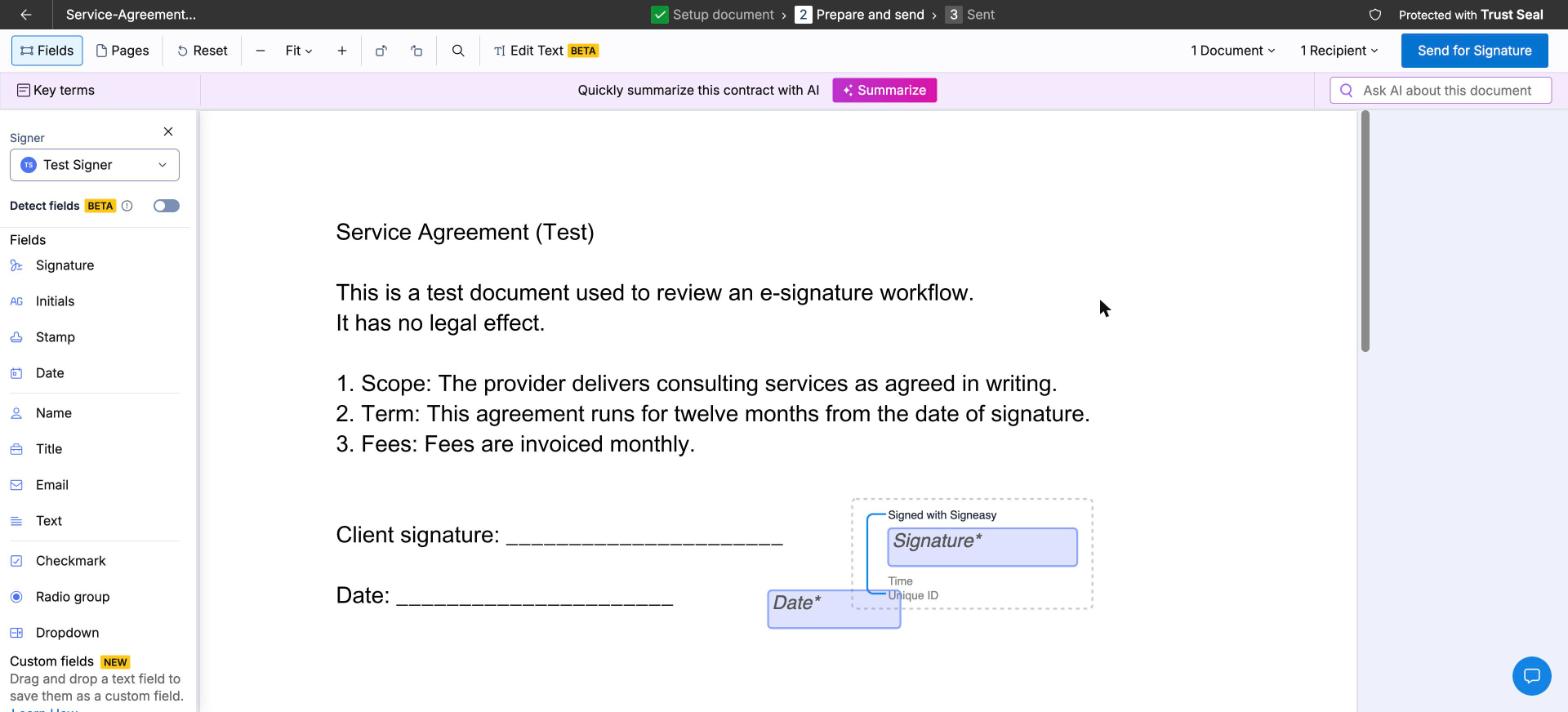
Our Signeasy send flow offered an optional contract type, approvers, signers with optional SMS and two-step verification, and observers. The editor included Detect fields in beta and an AI Summarize bar. The default expiry was 90 days.
The signer link opened straight into the document. A signature could be typed, drawn, uploaded or saved. Signeasy added a Signed with Signeasy frame around each signature by default, and the date filled automatically in US format as 11/10/26.
Sending With DocuSign
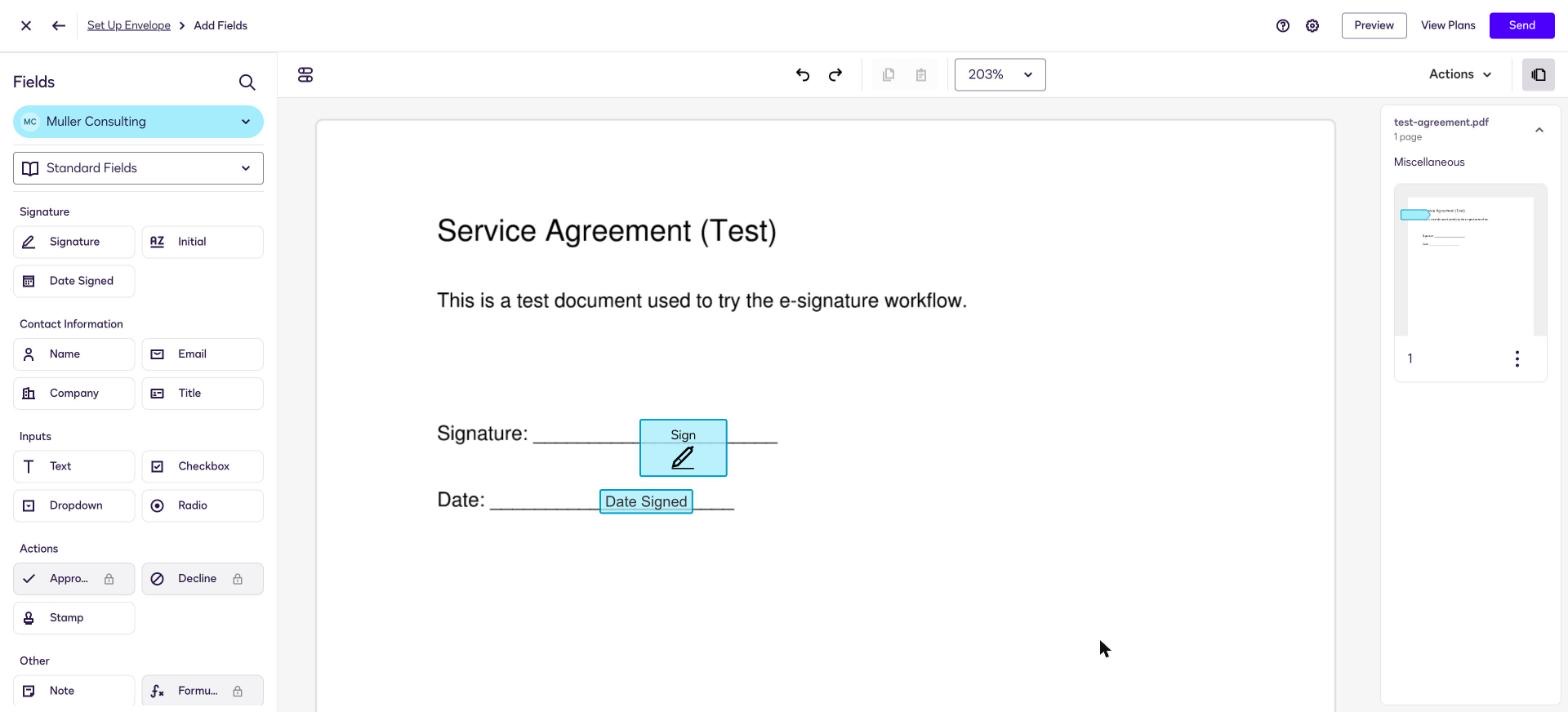
In our DocuSign test, fields were placed by hand. AutoPlace worked from anchor text that we added to the document ourselves. The default envelope name was Complete with Docusign: <file>. The request was set to expire four months after sending without the send flow asking. These defaults are worth checking before a team sends its own agreement.
How the Signing Experience Compares With Sign.Plus
Sign.Plus Auto-Place suggests fields right after upload, including flat scans. That differs from the manual field placement in our DocuSign test and Signeasy's beta Detect fields option. Per-recipient passcode, SMS code and ID Check controls are available, and every signed document comes with a Certificate of Completion. Sign.Plus is the third option for teams assessing suggested fields and verification tools.
7. Signeasy API vs DocuSign API
Signeasy offers a free sandbox, then Intermediate and Advanced plans priced by yearly request volume, and Build Your Plan by quote.
DocuSign adds a developer account and APIs on Business Pro, not Standard. API sends count against envelopes, so an integration needs both API access and sufficient envelope capacity.
Sign.Plus API plans have published prices and a monthly request allowance, and every plan supports SES, AES and QES. These are standalone plan specifications rather than a like-for-like price comparison with the different request and envelope models above. See Sign.Plus API pricing for the third option.
8. Single Sign-On (SSO)
Signeasy lists SSO on Build Your Plan and also sells it as an add-on on Business Pro through sales, with no published price. DocuSign reserves SSO and access management for Enhanced, which is quote-based and listed for 50 or more users; it is not included on Standard or Business Pro.
Sign.Plus includes SSO on Enterprise at $49.99 per user per month annually, with no user minimum. That gives smaller teams a published third option, while the other two require a sales conversation for SSO.
9. Contract Terms and Canceling
Signeasy plans auto-renew, and canceling keeps the plan active to the end of the period. Its refund language conflicts: the pricing page offers a 100-day money-back guarantee on yearly plans, the help center says refunds are available up to 30 days after purchase, and the terms say charges are non-refundable unless otherwise specified. Confirm the applicable policy in writing. Exceeding a plan limit can also move you to a higher plan, and upgrade fees are non-refundable.
DocuSign annual plans can be canceled within 30 days without penalty, once per customer. After that, the remaining balance of the annual subscription is owed. Subscriptions renew.
Sign.Plus remains the third option, but its cancellation and refund terms were not part of the verified facts used here. Review its current subscription terms before buying, just as with the other two products.
Check Recent Signeasy and DocuSign Reviews
Search for recent comments that identify the reviewer's plan and sending volume. Useful search prompts include:
- Signeasy review 2026 unlimited sending fair usage refunds
- Signeasy HIPAA SSO add-on review
- DocuSign review 2026 100 envelopes cancellation
- DocuSign Enhanced QES data residency HIPAA review
For the third option, search Sign.Plus review 2026 QES storage HIPAA and compare recent comments with the current plan details.
Final Verdict: Signeasy vs DocuSign
Signeasy is the simpler per-seat choice when Business's unlimited sending, fair usage, five shared templates and standard workflow cover the job. Its sales add-ons matter if you need SMS, bulk send, SSO or HIPAA.
DocuSign is the established choice with broader team packaging and integrations, but envelope consumption is central to its cost. US buyers also need quote-based Enhanced for QES, residency, HIPAA and SSO.
Sign.Plus is the third option if your priorities are unlimited requests, QES on every plan, Swiss default storage, a 43-location choice on Enterprise and HIPAA at a published price. Match its templates, verification, API and contract terms to your workflow before deciding. You can start a Sign.Plus free trial to test that fit.
FAQs
Is Signeasy better than DocuSign?

Is Signeasy cheaper than DocuSign?
Is Signeasy free?
Is Signeasy legit?
Does Signeasy support QES?
Is Signeasy HIPAA compliant?

Featured Articles






Confédération Suisse
Confederazione Svizzera
Confederaziun Svizra
Swiss Confederation
Innosuisse - Swiss Innovation Agency